Three Popular Austin Flooring Options Compared
When Austin homeowners and business owners consider upgrading their concrete floors, three options dominate the conversation: epoxy coating, ceramic or porcelain tile, and polished concrete. Each has distinct strengths and limitations that make it ideal for certain applications. This guide compares all three across the factors that matter most — cost, durability, maintenance, aesthetics, and suitability for Austins climate.
Cost Comparison
Epoxy flooring: $3 to $10 per square foot installed, depending on the system. A standard 2-car garage runs $1,800 to $4,500. Decorative flake systems average $5 to $7 per square foot and metallic systems $7 to $10.
Tile: $8 to $20 per square foot installed, including materials, mortar, grout, and labor. A 2-car garage tiled with porcelain costs $3,600 to $10,000. Premium large-format tile with minimal grout lines pushes costs even higher.
Polished concrete: $3 to $8 per square foot depending on the gloss level. A 2-car garage polish runs $1,500 to $4,000. Decorative options like dyed or exposed-aggregate polishing add $1 to $3 per square foot.
Winner on cost: Polished concrete for basic finishes, epoxy for decorated floors. Tile is the most expensive option for comparable square footage.
Durability and Performance
Epoxy: Exceptional impact resistance, chemical resistance, and abrasion resistance. Handles dropped tools, hot tires, oil, and solvents without damage. Lasts 15 to 20 years in residential settings. The flexible polyaspartic topcoat handles Austins temperature swings without cracking.
Tile: Hard and scratch-resistant but vulnerable to impact damage. A dropped hammer or heavy tool can crack individual tiles, requiring costly replacement. Grout lines collect dirt, stain easily, and require regular sealing to prevent moisture penetration. In garages, tire traffic on grout lines accelerates deterioration.
Polished concrete: Very hard surface resistant to abrasion and foot traffic. However, polished concrete is more susceptible to staining from oil, chemicals, and colored liquids because the surface — while dense — is not sealed as completely as epoxy. Impact resistance is moderate; heavy drops can chip the polished surface.
Winner on durability: Epoxy for garages and high-use areas. Polished concrete for light-traffic living spaces. Tile is least suitable for garage environments.
Maintenance Requirements
Epoxy: Sweep and mop occasionally. No waxing, sealing, or specialty maintenance required. Spills wipe up instantly from the non-porous surface. Essentially maintenance-free for years.
Tile: The tile surface is easy to clean, but the grout lines require regular attention. Grout must be sealed every 1 to 2 years to prevent staining and moisture penetration. Cracked or chipped tiles need individual replacement, which can be difficult if the exact tile is no longer available.
Polished concrete: Dust mop and wet mop as needed. No grout to maintain. However, polished concrete needs periodic resealing (every 2 to 5 years) and may require re-polishing every 5 to 10 years in high-traffic areas to maintain its gloss level.
Winner on maintenance: Epoxy requires the least ongoing care of all three options.
Aesthetics and Design Options
Epoxy: Available in solid colors, decorative flake blends (60+ options), metallic effects (40+ colors), and custom designs. Can mimic the look of stone, granite, or flowing marble. The most versatile decorative option for garage and basement applications.
Tile: The widest selection of colors, patterns, and sizes available. Can replicate the look of wood, stone, marble, and virtually any material. Offers the most design flexibility for indoor living spaces where the tile aesthetic is desired.
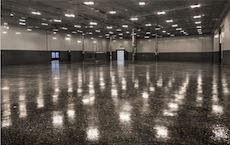
Polished concrete: Sophisticated, minimalist aesthetic in a range of gloss levels from matte to mirror-like. Can be enhanced with stains and dyes for color, or aggregate exposure for a terrazzo-like effect. The most architecturally distinctive option for modern Austin homes and commercial spaces.
Winner on aesthetics: This is subjective. Tile wins for traditional interior spaces, metallic epoxy for dramatic garage floors, and polished concrete for modern minimalist design.
Austin Climate Considerations
Austins climate creates specific challenges for each flooring type. Summer temperatures regularly exceed 100 degrees, UV exposure is intense, humidity fluctuates significantly, and occasional freeze events stress flooring materials.
Epoxy with polyaspartic topcoat handles all Austin climate conditions — UV stable, temperature resistant, and moisture proof. The flexible topcoat absorbs thermal expansion without cracking.
Tile is susceptible to grout cracking from thermal expansion and moisture penetration. In Austin garages where temperature swings are extreme, grout failure is a common issue that leads to water intrusion and tile loosening.
Polished concrete handles temperature well since it is the concrete itself, but the sealer can be affected by UV exposure and requires more frequent reapplication in Austin than in milder climates.
Frequently Asked Questions
Which is best for an Austin garage: epoxy, tile, or polished concrete?
Epoxy is the best choice for Austin garages by a significant margin. It provides superior chemical resistance, impact protection, hot-tire resistance, and maintenance-free performance that tile and polished concrete cannot match in a garage environment. Tile grout fails quickly under tire traffic and chemical exposure, and polished concrete stains too easily from automotive fluids.
Is polished concrete or epoxy better for an Austin restaurant?
Both work well for Austin restaurants, but they serve different aesthetics. Polished concrete delivers a trendy industrial look popular in East Austin establishments. Epoxy provides better moisture protection and chemical resistance for kitchen areas. Many restaurants use polished concrete in the dining area and epoxy in the kitchen and prep areas for the best of both worlds.
Can I install tile over existing epoxy flooring?
It is not recommended. Tile adhesive does not bond well to epoxy surfaces, and the resulting installation will likely fail. If you want to switch from epoxy to tile, the epoxy must be completely removed first, which adds significant cost. This is another reason to choose your flooring system carefully from the start.
Get Expert Flooring Advice
Not sure which option is right for your Austin property? Contact us for a free consultation. We install both epoxy coatings and polished concrete, and we will give you honest advice on which system best fits your space, budget, and goals. Call (512) 982-9592.